CNC Machine Tools - Guide to Automated Machining
Modern CNC machine tools are revolutionising the engineering industry. The abbreviation CNC (Computer Numeric Control) refers to the control of machine axis and tool movement by a computer program. Thus, the machine is not driven by a human, but by software that uses servo motors, ball screws and measuring systems for precise and repeatable movements. As a result, CNC milling, turning or grinding machines can produce complex shapes with extreme precision and stability, both in single pieces and in large batches. Automated production reduces human error and increases efficiency - machines can run continuously and quickly change the program to a new product.
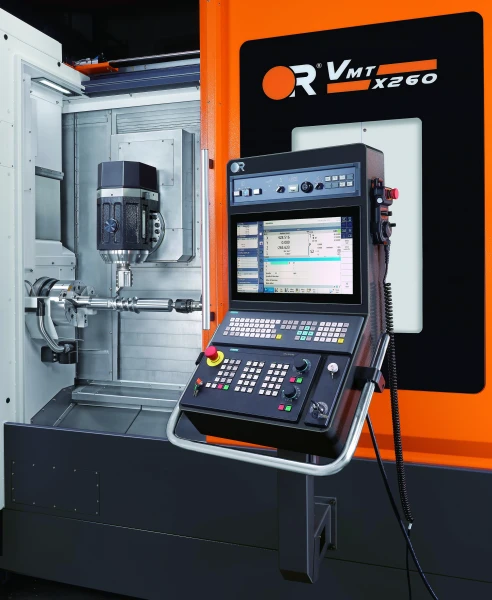
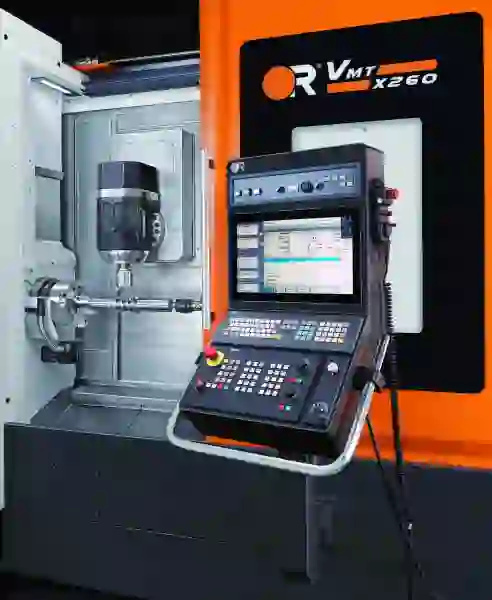
Division of CNC machine tools
The overview of CNC machines is wide and includes equipment for different types of operations. The basic division is based on which element is rotating during machining - whether the workpiece or the tool - and the number of axes.
Lathes and turning centres
CNC lathes are general-purpose machines designed for precision turning of rotating parts. They most often have 2-3 controlled axes and a turret head for 8 to 12 tools. Some models allow clamping of driven tools and therefore off-centre drilling or milling. Long-running machines (Swiss-type) specialize in the production of small cylindrical parts from bar stock. They are equipped with an automatic bar feeder and ejection of finished pieces, allowing continuous operation with minimal maintenance. Multifunctional turning centres combine the advantages of a lathe and a milling machine. They have a main and counter spindle, interchangeable tool trays and a swinging milling head, so they can perform a complete turning and milling operation in one clamping. Parallel machining on both spindles reduces production time.
Milling machines and machining centres
Vertical machining centres are versatile milling machines for smaller workpieces. They have a magazine of usually around 30 tools and a shoulder change. Standard spindle speeds are around 10,000 min-¹, but high-speed variants for mould machining applications reach 24,000 and exceptionally over 60,000 min-¹. Horizontal machining centres have the spindle mounted horizontally. Thanks to the rotary table, they can position and machine the workpiece from multiple sides. The design facilitates chip evacuation and is suitable for mass production of complex plate, case and rotary parts. Pallet changers allow overlapping machining and clamping times, so the machine runs continuously. Cantilever milling machines are designed for heavy milling of larger parts, usually with a horizontal spindle and swing head. Their robust bed provides high rigidity and vibration damping. Horizontal boring centres allow drilling, boring and milling of bulky weldments and housings. They are available in table-type (workpiece clamped on a rotary table) or plate-type (for longer workpieces). Thanks to the additional angle heads, it is possible to machine even hard-to-reach places. Gantry centres use stands connected by a gantry which carries a cross slide. Their main advantage is the rigidity of their construction and the ability to machine very large parts - traverses can exceed 2,000 mm and extend modularly up to 10,000 mm. Versions for forming applications are equipped with high-speed spindles of 15,000-24,000 min-¹. The five-axis milling centres allow the workpiece to be machined from multiple sides without the need to switch. They are equipped with a rotary and tilting table or a swinging milling head. Thanks to the interpolation of all axes, the milling tool can be guided along complex trajectories and produce shapes that cannot be created on a conventional machine. Multitasking is a new trend - five-axis centres can also perform turning operations.
Practical applications of CNC machines
CNC machine tools are used in all branches of engineering. In the automotive and aerospace industries, they provide mass production of shafts, hubs, blades and other rotating parts. In the energy and heavy engineering industries, they are used for machining flanges, turbine impellers, bearing housings and large housings. Thanks to their high precision and repeatability, they are also used in medical technology, electronics and mould making. Multifunction centres allow complex components (e.g. gearbox housings or pump bodies) to be produced in a single clamping, which reduces production time and increases quality.
Tips for choosing a CNC machine tool
Buying a CNC machine is a strategic investment and it pays to take the time to do a thorough analysis. It is a common perception among the general public that just pressing the "green button" will turn a semi-finished product into a finished product. Such a view is indicative of ignorance of the construction and operation of the machine. When selecting a machine, it is necessary to combine financial and technical considerations and ensure that the machine realistically meets the expectations of everyone involved.
What to look for:
- Type of workpiece and technology - first, be clear about the material, shape and size you will be machining. There are no one-size-fits-all machines; therefore, it is essential to select a design suitable for
for the desired operation. Make sure the machine can machine the most complex part of your production.
- Design and performance - evaluate the rigidity of the frame, bed and guide as they affect the stability of the machining operation. Look at parameters such as travel, spindle diameter, speed and available power
motor. For heavier machining, choose cantilever or horizontal machines with a robust design.
- Control and software - the type of control system (FANUC, Siemens, Heidenhain) is important. It must be user friendly, support the required cycles and smooth interpolation,
and ideally allow integration into enterprise systems (MES, ERP).
- Automation and tool capacity - for milling centres the number of tools in the tool magazine and the speed of change is important, for lathes the number of positions in the turret head. Pallet
systems and robotic operators enable unattended operation and higher productivity.
- Accuracy and stability - be guided by certified manufacturing accuracy (not just positioning data). Consider the impact of stiffness, geometry, thermal stability, measurement and
environment on the final part.
- Operator and maintenance competence - consider whether you have qualified operators and technology. Without trained personnel, even a top machine can fail. The quality of service and availability of spare parts, as well as manufacturer references, are also part of the evaluation.
How TDZ Turn does it
TDZ Turn is known for manufacturing vertical and horizontal lathes, but the company also helps customers select CNC machine tools for a variety of applications. The HLC series CNC lathes include S, M and L models - these are robust CNC machines designed for small batch production of rotating parts. The length between tines is variable from 2 to 12 metres, the running diameter reaches 530-1100 mm and the bed is 435, 558 or even over 1000 mm wide. The cast iron castings and hardened guide surfaces used dampen vibrations, ensuring rigidity and long-term accuracy. The spindle can be supplied with a drilling range of 104-410 mm and the machines can hold workpieces up to 10,000 kg (S version), 20,000 kg (M version) or 40,000 kg (L version). A standard Siemens Sinumerik or FANUC control system provides user-friendliness and customization options. In addition to the horizontal lathes, TDZ Turn also supplies VSC and VLC vertical lathes with 1,250-4,600 mm orbital diameter for machining large flange parts, BMC horizontal boring machines for drilling and milling weldments, and Victor Taichung VMT X200-X400 milling-turning centers that combine five-axis milling and turning in one machine. With years of experience, the company offers comprehensive service, installation and training, and helps customers navigate the technical parameters to select the optimal machine.
Summary
CNC machine tools enable the production of complex parts with high precision and repeatability, while saving time and costs. Choosing the right machine depends on the type of workpiece, the technology required, the level of automation and the available capacity. Basic types include lathes, long-running automatic machines, multifunction centres, vertical and horizontal milling machines, horizontal boring machines, gantry machines and five-axis centres. When selecting, consider structural rigidity, spindle power, steering, number of tools and supplier support. If you are considering a CNC lathe or machining center, contact us. We'll be happy to help you find a suitable model from our range of CNC lathes or recommend the optimum vertical or horizontal machine. Contact the TDZ Turn sales department to find out more about automated machining options.